Business Case Development
Introduction
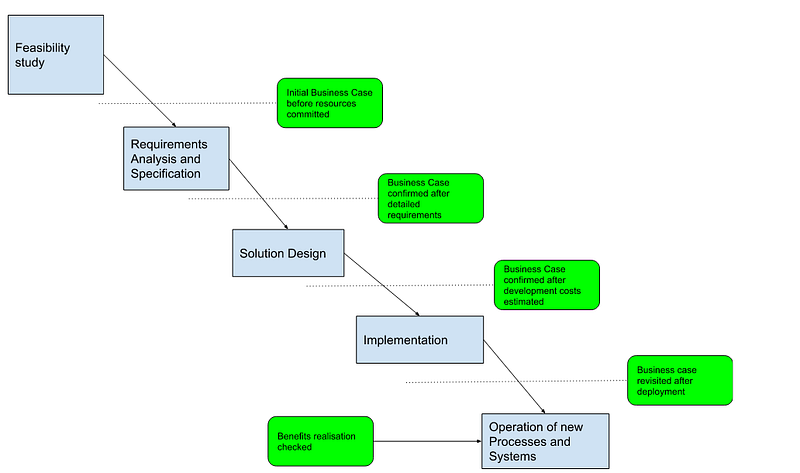
When Unhappy Bank faced a problem or an opportunity, it explored various solutions before selecting one. However, before making any commitment to a particular solution, it was important to evaluate the feasibility and potential outcomes of each option. This is where a business case comes in — it is a document that presents different courses of action to a decision maker and offers recommendations based on the analysis conducted. In this way, a business case helps stakeholders make informed decisions and avoid potential risks or pitfalls.
Each business case had three objectives. To Identify and describe a business need, to justify the cost and to provide information so that it was prioritised.
Contents of a Business Case
A business case can contain different sections. The starting section is the management summary that consists of three paragraphs, outlining the study, the options considered, and the clear recommendation. The next one is the description of the current situation which explains where the opportunities and problems are. Following is the options section that considers any alternative options, along with explanations of why these are not recommended. Next is the costs and benefits section of the proposed project, with a focus on the benefits before costs. After that, is the impact assessment section that will look at the effects on organization structure, working practices, and management style. Then, a risk assessment should be done that will describe the risks, their probability, and recommended countermeasures. Finally a recommendations section that will include the conclusion of the business case.
Options
In business analysis, options refer to the different courses of action that a business can take to achieve its objectives or address a specific problem. Options can be defined as different strategies, alternatives, or solutions that are available to the business.
To define options in business analysis, it is important to first identify the problem or opportunity that needs to be addressed. Once the options have been identified, they should be carefully analysed and compared to determine the best course of action (shortlisted and evaluated). This analysis should consider factors such as the costs, benefits, risks, and impact on stakeholders associated with each option.
It is also important to consider the potential consequences of not taking action or delaying a decision (do nothing option), as this can impact the overall success of the business. The recommended option should be clearly presented, with a detailed explanation of why it was chosen and how it aligns with the business’s objectives and values.
Examples
Implementing a Mobile Banking App
| **Section** | **Description** | **Example** |
|----------------------------------|----------------------------------------------------------------|---------------------------------------------------------------------------------------------------------------------------------------------------------|
| Introduction | Why the business case is being presented | Bank has not yet implemented a mobile banking app although many customers are demanding more convenient and accessible ways to manage their Accounts |
| Management summary | Brief paragraph for management | Study on the option of developing a mobile. Options were an Android app and/or an iPhone app. It is recommended to develop both. |
| Description of current situation | Explains where the opportunities and problems are | Traditional banking services through the branches. Possibility of loosing existing and new customers. |
| Options | Other options considered | Do nothing. However this means that Bank might loose new and existing Customers. |
| Costs / Benefits | Costs that will be incurred and where benefits can be expected | While there is cost of the investment in technology and effort the potential benefits in terms of customer satisfaction and loyalty outweigh the costs. |
| Impact Assessment | Impact on the Bank | Increased customer convenience, attract younger customers and cost-effective |
| Risk Assessment | Description, probability, countermeasures | Security and technical risks, low probability, countermeasure is to use established mobile app frameworks and conduct thorough testing. |
| Recommendations | What are recommendations are | Implement two separate mobile apps for Android and iPhones using a well established mobile app framework. |
Options for a Mobile Banking App
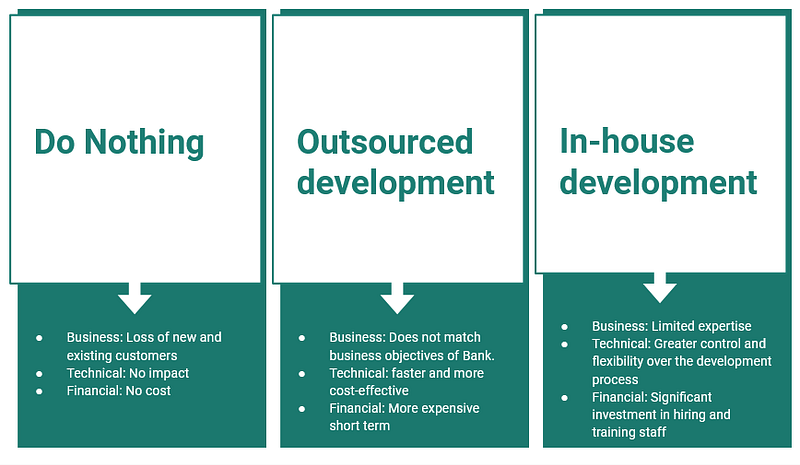
The below diagram illustrates the three options that were considered for developing a mobile banking app. The “do nothing” option was rejected because of the business impact. Despite the fact that in-house development offered the greatest advantages from business, technical, and financial perspectives, a hybrid development approach was chosen as the fourth option. This involved outsourcing only the actual implementation while keeping the analysis, testing, and maintenance teams in-house.
Cost/Benefit Analysis of a Mobile App
Finally, a cost/benefit analysis was conducted regarding the development of a mobile app for a Unhappy Bank.
Costs:
- Development costs: Developing a mobile banking app was estimated to be expensive and required a significant investment in development resources, including software development, design, testing, and deployment.
- Maintenance costs: Once the app was launched, there would be ongoing maintenance costs, including bug fixes, updates, and security patches.
- Security costs: Additional investment in security features and resources to protect against potential fraud and cyberattacks.
- Integration costs: Banks needed to integrate their mobile app with their existing IT infrastructure, which was required additional investment.
Benefits:
- Increased customer satisfaction: A mobile banking app could provide customers with easy access to their accounts and transactions, allowing them to manage their finances more easily and conveniently. This could lead to increased customer satisfaction and loyalty.
- Improved engagement: A mobile banking app could help banks to engage more effectively with their customers, providing them with personalised offers and recommendations based on their transaction history and preferences.
- Cost savings: A mobile banking app could reduce the need for customers to visit bank branches or call customer service, leading to cost savings for the bank.
In conclusion, developing a mobile banking app could be costly, but it offered a range of benefits, including increased customer satisfaction and engagement, cost savings, and a competitive advantage. The costs and benefits will vary depending on the specific requirements of the bank and the market in which it operates.