How Stuff Works (in a Bank)
Introduction

The next stage was for Unhappy Bank to have a conceptual view of business activities as a single consensus model which all stakeholders found agreeable. This model was a view of what the business activities should look like.
Understanding the existing processes within the bank was crucial for identifying areas that may required improvement or optimization. By analyzing the current methods, bank could identify any weaknesses and problems that may be hindering it’s efficiency and effectiveness.
Unhappy Bank managed to take the transformation elements in a stakeholder perspective modelled in a CATWOE and ‘draw’ them
into the Doing activities in a BAM (Business Activity Model).
CATWOE
The CATWOE technique is a technique that helps organizations to identify the key components of a problem and to develop potential solutions. The acronym CATWOE stands for Customers, Actors, Transformation Process, Worldview, Owners, and Environmental Constraints. This technique was first introduced by Peter Checkland in the 1970s as part of his soft systems methodology approach to problem-solving.
In Unhappy’s Bank CATWOE analysis the Customers of the bank were individuals or businesses that use the bank’s services, such as depositing and withdrawing money, obtaining loans, or investing funds. The Actors in the bank included the bank employees who worked in various departments such as customer service, loan processing, investment management, and marketing. The Transformation process in the bank involved the handling of financial transactions, which includes receiving deposits, granting loans, providing investment advice, and managing risk. The Worldview of the bank was shaped by the economic, social, and political environment in which it operated.
Business Activity Model — BAM
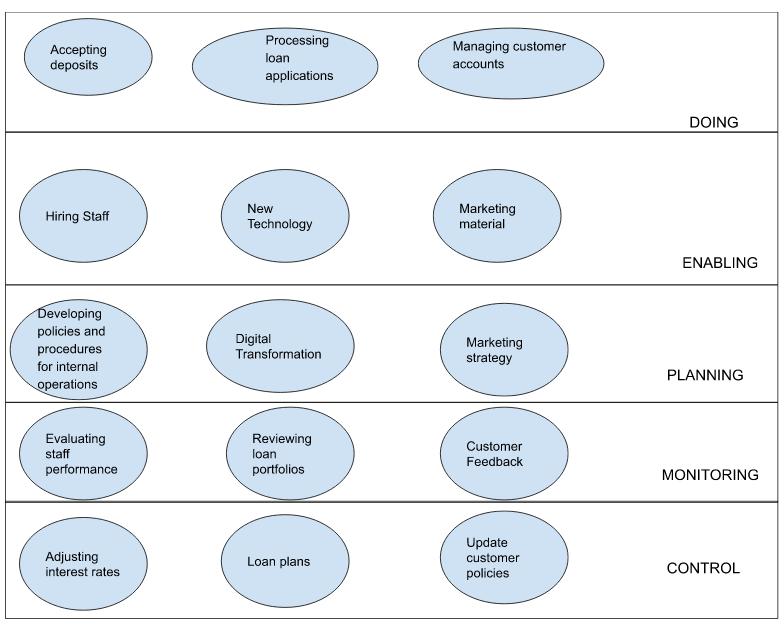
When it comes to managing an organization, having a clear understanding of what needs to be done and how to do it is essential. While the CATWOE technique modelled the stakeholder’s perspective, a business activity model provided a more comprehensive view of what the Bank should be doing. The model outlined the specific steps that needed to be taken to achieve particular outcomes.
In this context, five key types of activities needed to be identified and incorporated into the process model to ensure its effectiveness. These included doing, enabling, planning, monitoring, and control activities.
- The doing activities outlined the core processes required to achieve the outcome.
- The enabling activities provided the necessary resources to support these processes.
- The planning activities involved creating a roadmap for achieving the outcome.
- The monitoring activities tracked progress towards this goal.
- Finally, the control activities were used to make adjustments if performance is not as expected.
The next diagram illustrates one of the BAMs that was developed for Unhappy Bank.
Business Events
A business event is a specific action or occurrence that prompts the business system to take action. These events serve as indicators of when a business activity should be initiated. There are three main types of business events: external, internal and time-based. External events occur outside the organization, while internal events are generated within the business system, such as the loan department deciding to reduce the interest rates of loans. Additionally, events can be time-based, occurring at regular intervals, such as monthly statements. Analysing business events can provide valuable insight into the operations of an organization, helping to identify patterns, optimize processes, and drive decision-making.
Below are some of the business events that were recorded for Unhappy Bank.
External Events:
- A customer deposits money into their account
- A customer withdraws money from their account
- A customer applies for a loan
- A customer opens a new account
- Changes in government regulations impacting banking operations
- Economic changes that affect interest rates and investment opportunities
Internal Events:
- A bank manager approves a loan application
- A bank teller balances their cash drawer
- A customer service representative handles a customer complaint
- A bank employee attends a training session
- A new investment opportunity is identified
- An IT system upgrade is scheduled
- A compliance audit is conducted
Time-based Events:
- Monthly account statement generation
- Interest payments on savings accounts
- Loan payment due dates
- Annual budget preparation
- Quarterly performance review meetings
- Annual regulatory reporting requirements
- Daily reconciliation of accounts
These business events provided a snapshot of the different actions and occurrences that took place in a bank, and served as a basis for analysis and optimisation of the bank’s operations.
Business Rules
Business rules are a set of guidelines that dictate how business activities should be conducted. In other words a business event happens a specific Action is triggered according to business rules.
There are two main types of business rules: constraints and operational guidance. Constraints refer to external legal and regulatory limitations, as well as internal policies. Operational guidance, on the other hand, outlines how procedures should be executed within the organization. These rules are relevant to both business process and system process modeling, and while some may be universally accepted, it’s important to consider alternative approaches.
Below is a list of business rules identified for Unhappy Bank.
Constraints:
- Compliance with banking regulations and laws
- KYC (Know Your Customer) requirements
- AML (anti-money laundering) policies
- Limitations on the types and amounts of loans offered
- Required minimum balances for certain types of accounts
Operational Guidance:
- Guidelines for managing employee schedules and responsibilities
- Standards for IT security and data protection
- Protocols for handling customer complaints and inquiries
These business rules helped ensure that the bank’s operations complied with legal and regulatory requirements, as well as internal policies and procedures. They also provided a framework for consistent and efficient execution of banking activities.
Gap Analysis
Gap analysis is a process that involves comparing two different views of a business situation in order to identify the differences between them. These differences provide the basis for defining the necessary actions required to achieve the desired state. Typically, the two views being compared are the current state and the desired state.
The process for gap analysis involves several key steps. First, the current situation is investigated and modeled to gain a thorough understanding of the current state. Next, different perspectives are analysed to identify the various aspects of the current situation that need improvement. Finally, the current state is compared to the desired state in order to identify the differences that exist and determine what actions are necessary to bridge the gap.
Below is an example of Unhappy Bank for their card management system.
Current state: The bank was using an outdated system for Card management. The system was slow, prone to errors, and did not integrate with other systems used by the bank.
Desired state: The bank wanted to upgrade its Card Management System (CMS) to a modern, cloud-based system that was more efficient, reliable, and scalable. The new system should also integrate with other systems used by the bank using real time APIs.
Steps:
- Investigated and modeled the current IT system to identify its strengths and weaknesses.
- Analysed the perspectives of different stakeholders, including employees, and management to determine their requirements and expectations for the new system.
- Compared the current CMS to the desired state, identified the differences between the two systems.
- Identified the actions required to bridge the gap between the current and desired states. This include migrating data to a new cloud based system, implementing additional functionality on the new system, and providing training to employees.
- Developed a plan for implementing the new system, including a timeline, budget, and resource requirements.
Lastly, an alternative way to organise a gap analysis can be the Popit model.