How to Document a Business Situation
Introduction
Different investigation techniques can be used to document a business situation. They can be classed as either quantitative or qualitative. This article discusses the investigation techniques used for the digital transformation project of Unhappy Bank.
Interviews
These are personal comprehensive examinations carried out by the analyst to any stakeholder.
- Pro: wide range of viewpoints.
- Con: Time consuming
In Unhappy Bank, interviews were exclusively conducted with a select group of employees known as Subject Matter Experts (SMEs). SMEs are individuals with extensive experience, having been involved in various projects and possessing knowledge that may only exist in their minds. Lastly, it was critical to gain their approval of the digital transformation project’s changes.
Workshops
A large group of stakeholders get together to discuss the requirements of a project.
- Pro: Efficient
- Con: Difficult to organise
The bank designated 1–2 representatives from each department to act as project ambassadors. These individuals were then invited to attend workshops during the project’s definition phase with the objective of providing an overview of the bank’s strategy and how the digital transformation project aligns with it. As a result, the ambassadors gained a thorough understanding of the project’s scope and effectively communicated its benefits to their respective team members.
Observation
In this investigation technique, business analysts observe stakeholders and take notes.
- Pro: Stakeholders do not need to allocate time
- Con: People don’t like to be watched
This technique was used for end-users. These users performed their daily tasks (usually repetitive) and as they navigated through the existing systems, the business analysts were taking notes on any issues or areas of improvement. The feedback was then used to improve the user experience and ensure that the system meets the needs of its users.
Questionnaire
In this investigation technique, a list of questions guides stakeholders to explain their requirements.
- Pro: Helps stakeholders to express their requirements
- Con: Collecting data can be a challenge
Questionnaires proved to be beneficial when particular systems were being replaced by other systems that could only be configured and not customised. The questionnaire contained specific questions tailored to those systems, resulting in end-users providing precise answers.
Scenarios
Specific sequence of actions that need to be performed for specific processes.
- Pro: Help build prototype
- Con: Can become complicate
Scenarios were given to SMEs and they were asked to design processes on paper using swimlanes. The resulted swimlanes helped to identify inefficiencies and bottlenecks in processes. By visually mapping out each step in a process and assigning each step to a specific department or individual, it became easier to see where delays or duplication of efforts occurred.
Another benefit of swimlanes was that they helped identify areas for automation or technology improvements. After all, this was a digital transformation project. By understanding the specific tasks and responsibilities of each department, business analysts identified areas where technology could be leveraged to streamline processes.
Finally, swimlanes helped to ensure that everyone involved in a process or project had a clear understanding of their role and responsibilities. By providing a visual representation of the flow of work, it became easier to communicate and coordinate efforts between departments or individuals.
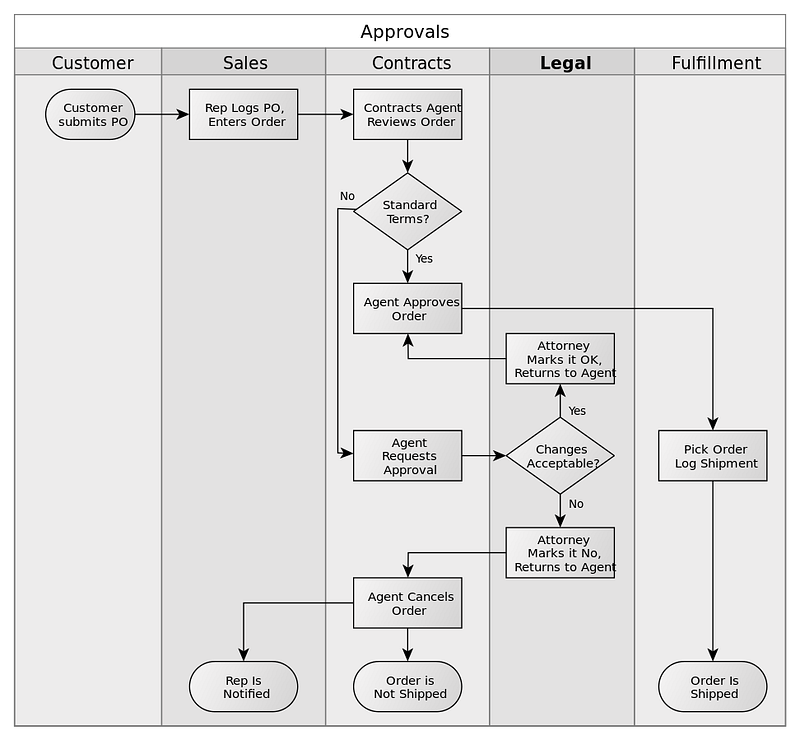 Source: https://commons.wikimedia.org/wiki/File:Approvals.svg

Applying the Techniques to Different Business Situations
- Interviews: small number of stakeholders.
- Workshops: large number of stakeholders.
- Observation: When job is repetitive.
- Questionnaire: time for preparation, system requires only configuration.
- Scenario: Stakeholder with deep knowledge of requirements.
- Customer journey maps: Visual representation of the customer journey. Useful for analysing sales processes to understand the emotional state of a customer.
- Rich pictures: To make sense of complexity.
- Mind maps: Useful for brainstorming and for root cause analysis.
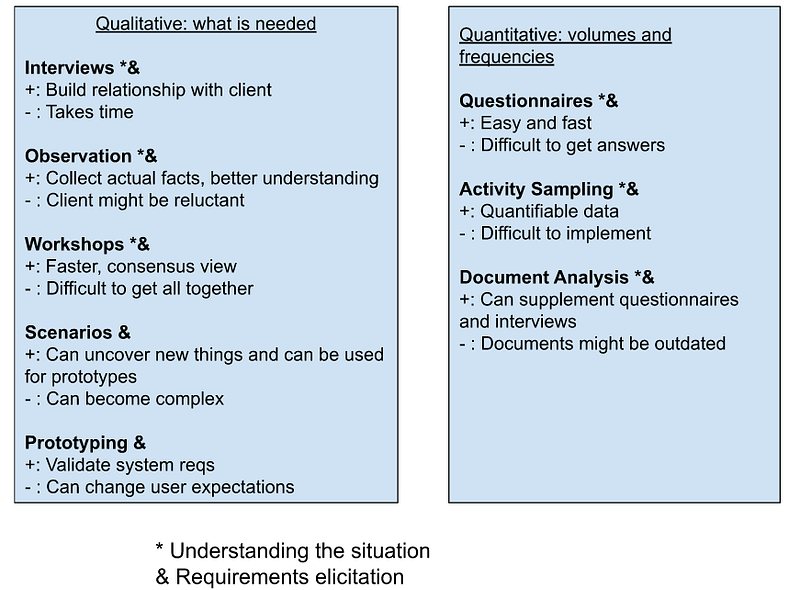
Below is a diagram that indicate where each technique is more suitable.
Conclusion
In conclusion, investigation techniques are a crucial component of business analysis as they allow for a deeper understanding of business processes, systems, and end-users. Techniques such as interviews, observations, and questionnaires provide valuable insights into how a business operates and what changes are needed to improve performance. The use of investigation techniques can help to identify inefficiencies, bottlenecks, and areas for improvement, as well as ensure that all stakeholders have a clear understanding of their roles and responsibilities.