Are Contact Tracing Apps the Solution to the Second Wave of the Covid-19 Pandemic?
A few months in after the first wave of Covid-19 cases and many countries have already started to relax their protective measures. However, scientists already warn about a second wave and propose various methods of preparation. One suggestion is to use contact tracing mobile apps to boost Covid_19 contact tracing efforts.
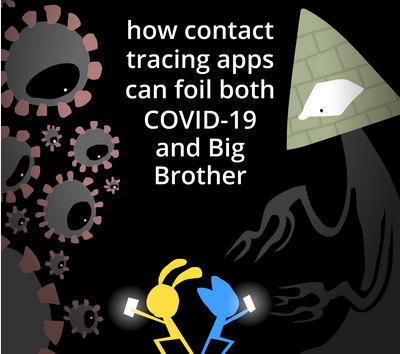 source: https://ncase.me/contact-tracing/
Experts agree that Covid-19 testing and tracing are important and is one of the best ways to understand the pandemic and how it spreads. The main principle is that people get tested and if they are found positive they get isolated and tracing begins. Then, their close contacts get tested and if they are found positive they get isolated, also, and so on. This subsequent step is called tracing. The below diagram indicates that tracing is successful, if all infected down to patient 0 (an already known positive case) are found and isolated, therefore preventing the virus from spreading further. Some experts call tracing an aggressive strategy since it is a proactive measure placing us a step ahead from the virus.
The below diagram illustrates contact tracing and how the chain of transmission can be broken.
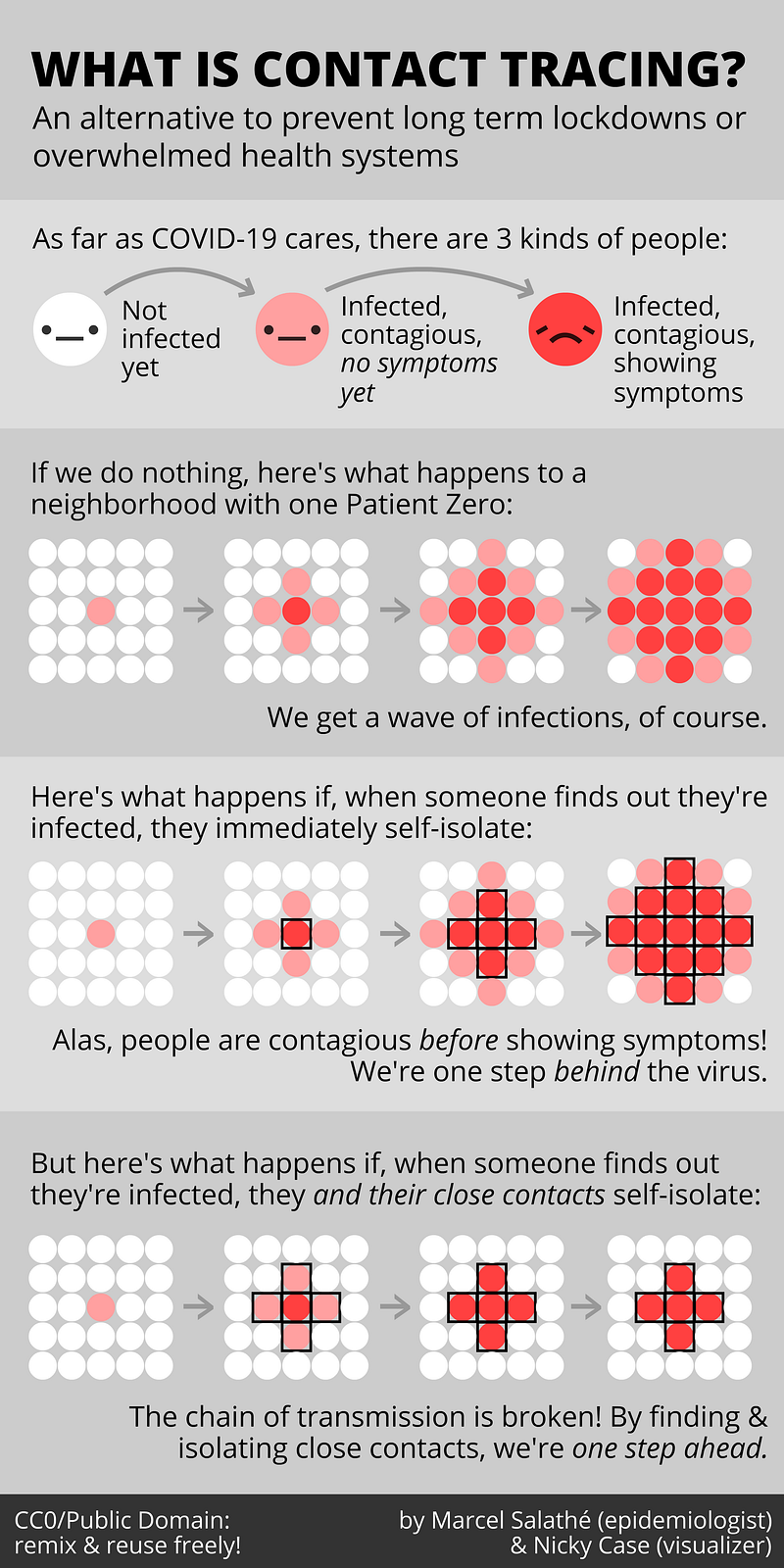 Contact Tracing. Source: https://commons.wikimedia.org/wiki/File:What_is_contact_tracing_COVID-19.png

Cyprus is using contact tracing to fight the spread of the disease. Although there are currently more than 800 positive cases in a population of around a million, there are very few orphan cases (i.e. where patient 0 is not found). The success of contact tracing is shown at the below graph which indicates that the curve is now flattened.
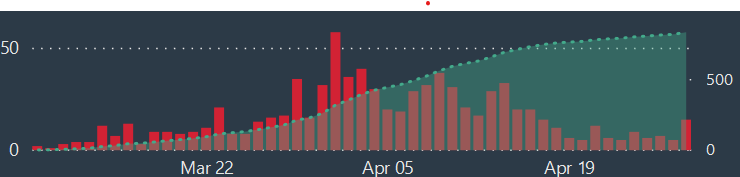 Cyprus positive cases. Source: https://covid19.ucy.ac.cy/
Contact tracing is done manually, so far. It requires the patient to recall all the people that they came in contact with, and also a team to trace those people, which is time consuming. Furthermore, another problem with this approach is that patients lie, as the world’s best doctor used to say. Can we automate this process and overcome this problem?
 Patients lie. Source: memegenerator.net
Experts argue that a second wave of coronavirus is coming. It already reached Singapore and is estimated to reach Europe after the Summer. Can we use technology to halt the second wave?
Technology is useful in automating manual jobs. Can we use a mobile app for contact tracing? The idea is simple. A mobile app keeps track of contacts and when a person is infected all the contacts are notified.
Any technologist that respects himself should always use an Alice and Bob example when writing, so here is my example:
Bob visits Alice’s house. After a few days, Alice goes for a covid-19 test and the test is positive. How can Bob be notified to go for a test, also, without the intervention of Alice or the government?
Bob and Alice have the same mobile app installed on their smartphones. When Alice finds out she is positive, she updates the mobile app of the result. The system begins tracing and retrieves all of Alice’s recent contacts. Eventually, everybody that came in contact with Alice, including Bob, gets notified by the system to go for a test or isolate.
Currently, there are many different implementations of this idea. I will try to analyze the main ones.
Google-Apple Partnership
Google and Apple have collaborated to provide a system for contact tracing. This partnership can have a world wide impact since these are the two companies that control the smartphone market. On other hand Google and Apple will need support from governments and officials of public health systems. NHS already rejected their plan and will focus on a more centralised system.
The solution uses Bluetooth technology and encryption. It will be rolled out in two phases:
- First phase: The API (Application Programming Interface) will be available to developers early May.
- Second phase: A system update will add the contact tracing functionality at the OS level (Android and iOS). This is expected later this year.
EFF (Electronic Frontier Foundation) published an article with some good recommendations for developers that will use the Google-Apple API.
Pan-European Privacy-Preserving Proximity Tracing (PEPP-PT)
PEPP-PT is a European consortium of companies and research centers. Their app will use anonymous tokens which will be transmitted between mobile devices through radio signals (Bluetooth, etc). The app will be GDPR ready. The consortium considers two approaches for the architecture: centralized and decentralized.
DP3T
DP3T is an international consortium of technologists, legal experts, engineers and epidemiologists. They are all working together in developing proximity tracing technology that not only protects our lives but also our liberty by focusing on privacy.
A fantastic comic illustrates how this app will work.
CovTracer
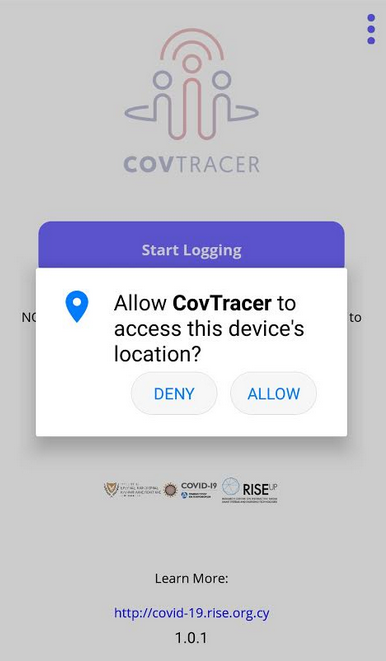
CovTracer is a mobile app developed in Cyprus by RISE Research center. It is based on MIT’s Safepaths project. I downloaded this app myself and I plan to use it.
Users can see the different locations that have been on a map. These locations are stored at the phone’s memory only, so there are no privacy concerns. If a user gets infected, he or she can choose to share a file (there is an import/export) functionality with the public health officials, who will be able to identify the places a carrier has visited. In other words, the carrier doesn’t need to remember all places visited, the mobile app will do that.
Other Developments
Top10VPN has a live document that tracks all developments around the world. The key findings are that there are contact tracing apps in 29 countries and physical surveillance technologies are in use in 9 countries.
The last part of this article tries to answer the title, whether contact tracing apps can help the prevention of a second wave.
Scenarios of Contact Tracing Apps Usage
Let’s consider some real life scenarios of how a contact tracing app might be used.
Scenario1:
You are in queue in a grocery shop and your mobile app sends you a notification. Someone that you were in contact recently has tested positive for coronavirus. You drop your tomatoes and lemons and rush to the nearest drive-in testing center. Your test is also positive, so you isolate yourself. The chain is now broken.
Scenario 2:
(less liberal)
Someone that you were in contact recently has tested positive for coronavirus. You get a notification in your mobile that you must rush to the nearest test center. However, the government also gets a notification and notifies you that you have 1 hour to go to the nearest test center. You are a responsible citizen, so you rush to get tested, your test is positive so you isolate yourself.
Scenario 3:
(dystopian)
Someone that you were in contact recently has tested positive for coronavirus. While waiting at the queue of a grocery shop, you get arrested and dragged to the nearest test center.
All the above scenarios can be considered as a success. The chain of infection is broken. However, how can we ensure that the second or (God forbid) the third scenario will not become a reality?
Privacy Issues
Academics and scientist all over the world published an open letter raising their concerns over contact tracing apps (pdf).
The open letter provides four privacy principles for contact tracing apps:
- Contact tracing apps must only be used to support public health measures for the containment of coronavirus cases.
- The solution must be transparent. Everything should be documented properly and available for public analysis.
- When there are multiple options to implement, the most privacy-preserving option must be chosen.
- The use of contact tracing apps must be voluntary. In other words no Scenario 3.
Usage of Contact Tracing Apps
Contact tracing apps can help the spread the corona virus but only when used correctly by responsible citizens.
They have to be used as a supplement to the human-led contact tracing efforts (or manual efforts that I mentioned). These apps assume that a mobile phone is a human and this is not always correct. Many people do not have smartphones (kids, elders, etc) and phones can run out of battery or left in the car while visiting a shop.
People should still be educated how to use their smartphone, what they need to do and who to contact in case their test results are positive. The investigation should still take place, but it can be supplement by the results of a contact tracing app. Appropriate education will lead to better use. Carly Kind, the director of the Ada Lovelance Institute published a review that argues that bad uses of data and technology can do more harm than good.
Conclusion
I will finish this article with what I believe are the prerequisite for contact tracing apps to work properly:
Responsible citizens
Transparent governments.