Lifecycle of a Business Change
Introduction
Let’s start by defining what is a business change. Business change refers to the process of modifying the way a business operates or the processes and systems that it uses to achieve its goals. It can encompass a wide range of changes, from minor adjustments to major restructuring initiatives. Unhappy Bank wanted to have many different major business changes and this is why they asked for a digital transformation project.
Unhappy Bank’s goal of business changes was to improve the organisation’s performance, increase efficiency, and enhance its ability to adapt to changing circumstances.
Business Change Lifecycle
A well known acronym that is used for the lifecycle of a business change is ADDIR. Let’s go through the different stages.
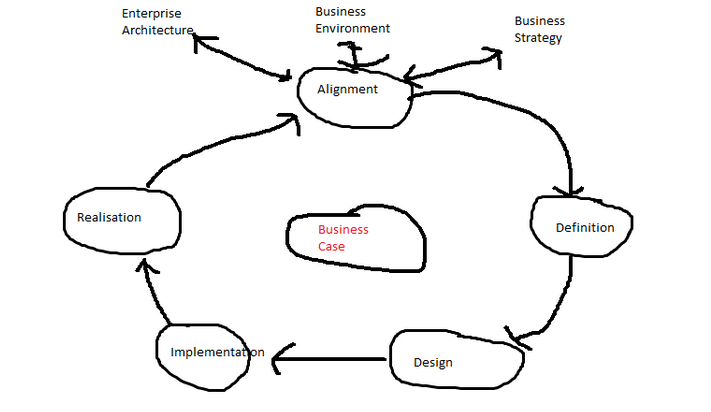 I do business analysis, not graphic design.
Alignment
This is the initial stage. It is used to link an organisation’s strategy to its external environment. A Business Analyst needs to be aware of the external environment and make recommendations for change.
Unhappy Bank’s strategy can be found in the article that analysed Unhappy Bank’s Business environment. To ensure that the digital transformation project is aligned with this strategy the Bank decided to :
- Review customer feedback to identify areas where a process can be improved. In other words, listen to it’s customers.
- Conduct market research to identify industry best practices and benchmark against competitors, especially fintechs.
- Engage with employees to communicate the proposed change and address any concerns or feedback. It is important to keep in mind that the effectiveness of a system is largely dependent on the users who utilise it.
Definition
The second stage where the elements that will support the change are defined. A high level document was prepared that included Unhappy Bank’s vision and then a strategy was deployed to communicate that vision to all employees, especially the decision makers.
A Business Analyst is needed at this stage to run a feasibility study and search for options, to manage stakeholders, perform a gap analysis and finally define the requirements.
Design
Prior to implementation, it was necessary to develop a design that encompassed new or improved business processes, IT applications that were affected, and the testing procedures to be employed.
The role of the Business Analyst includes defining acceptance criteria for testing, acting as a liaison between the business and IT teams, and ensuring that the end product aligns with the business needs. By fulfilling these responsibilities, the Business Analyst helps to ensure that the IT team delivers what the business requires, thus avoiding any potential mismatch between expectations and actual results. In other words, when Business wants oranges, IT team will deliver oranges and not lemons.

Implementation
This is the stage of the actual implementation. The project team with the developers should have a clear tasks to be implemented at this stage. A Business Analyst is required to ensure that the development tasks are clear by supporting the project team. Furthermore, the business analyst was responsible for managing change requests that arose during the implementation phase, ensuring that any changes align with the overall project objectives.
Realisation
Once the project is real and the go-live phases have passed, then we needed to ensure that the digital transformation project was successful and had the benefits it was suppose to have.
Business Analyst was required to perform a post implementation review and suggest future improvement opportunities.
Waterfall vs. Agile Solution Delivery
Waterfall (or linear) and iterative (or agile) approaches are two project management methodologies used to manage projects in various industries. Here’s a comparison of the two approaches.
Waterfall Approach
The linear approach is a traditional project management methodology that involves sequential phases. Each phase must be completed before the next phase can begin. Going back to the previous Section, an example could be that the stage of Implementation could only start after a clear design (or a signed-off design) was in place.
Advantages of Waterfall approach:
- Well-structured and easy to follow.
- Works well for small projects with well-defined requirements.
- Simple and easy to understand for all stakeholders.
Disadvantages of linear approach:
- Does not accommodate change well.
- Lack of flexibility.
- High risk of project failure due to issues identified late in the project.
Agile Approach
The iterative approach is a project management methodology that involves continuous delivery and incremental improvement. Iterative projects are divided into sprints, with each sprint focused on delivering a working product. The iterative approach typically follows these steps:
- Planning
- Execution
- Review
- Adjustment
Advantages of iterative approach:
- Encourages customer involvement and feedback.
- Adaptable to changing requirements.
- Encourages collaboration and team communication.
Disadvantages of iterative approach:
- Can be difficult to manage for larger projects.
- Can be challenging to estimate the timeline and cost of the project.
- Requires a high level of customer involvement and collaboration.
In summary, the waterfall approach is a good fit for projects with well-defined requirements and a fixed timeline, while the agile approach is better suited for projects with changing requirements and a need for flexibility. Ultimately, the choice between the two approaches depends on the nature and requirements of the project.
Conclusion
Overall, Business Analysts are critical members of the project team in a business change whether the project is waterfall or agile. They help to ensure that the change is properly aligned with the needs and goals of the business, and that the resulting solution meets the needs of stakeholders. This helps to minimize risk and increase the likelihood of a successful business change.