Use Case of Business Analysis: A Wedding Venue
Before publishing
- find all todo
After publishing
- table of contents
- internal links
Introduction
This story will analyse the use case of a small hotel that decided to become a wedding venue. The analysis will be done according to the suggested syllabus of BCS International Diploma in Business Analysis.
Hotel King Jason was a small hotel with 10 rooms. It also run a small restaurant for hotel guests and non-hotel guests. They decided to make weddings. They believed that converting the hotel to a wedding venue will offer couple exclusivity, …
Table of Contents
https://medium.com/informatics/how-to-insert-a-table-of-contents-into-medium-stories-810053e519#324a
1. The Business Context
1.1 The Rationale for Business Analysis
Hotel owner Alison knew nothing about projects so she decided to hire a business analyst. His name was Bob and he was be in charge of the following:
- Identify the business environment
- Align business needs and objectives
- Analyse processes and systems
- Business cases
- Stakeholders
- Analyse risk and impact
- Gather requirements
- Manage requirements
[TODO Links]
Bob started by conducting internal and external analysis.
Internal Analysis
- Resource Audit: What the hotel had at the beginning of the project
- SW (from SWOT analysis): Strengths and weaknesses
- VMOST analysis
External Analysis
- PESTLE
- OT (from SWOT analysis): Opportunities and Threats
1.2 Holistic View
It was important for Bob to have a holistic view of the organisation before starting the project. This would ensure that:
- There is alignment with Alison’s vision for her hotel.
- All dependencies were identified.
- A risk analysis was performed.
- An impact analysis would provide valuable feedback to Alison.
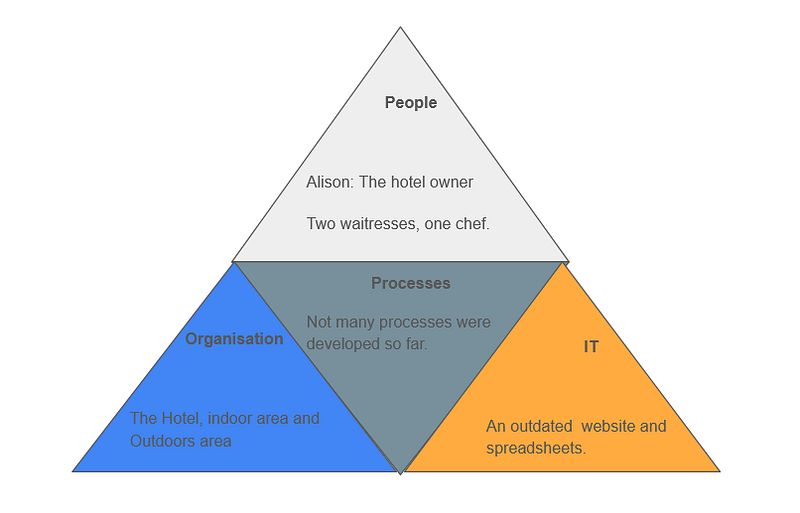
A method of doing that is through the POPIT Analysis.
People: Alison, the hotel owner, two waitresses and one chef so far.
Organisation: As described in the resource audit section (TODO link)
Processes: New processes will be developed and are described in the section TODO
IT: Information and Technology — Hotel had an outdated website. A new website was needed for three different purposes:
- Attract new couples
- Bookings
- Used for wedding planning management
1.3 Competencies of a Business Analyst
Alison understood that she needed a business analyst early at the beginning of the project. Bob was ideal for this project because he had competencies in the three different areas that a business analyst should have:
- Business Knowledge: Bob already worked for a similar project for another wedding venue so he knew what is needed to organise a wedding. Furthermore, Bob had enough technical background to translate requirements to system functionality required.
- Professional Skills: Bob was involved in many projects in the past so he knew all about project management. Furthermore he had all those business analysis skills required such as stakeholder analysis, requirements gathering and management.
- Personal skills: Bob was able to communicate efficiently, influence stakeholders, he was team player and had appropriate analytical skills.
1.4 Professionalism in Business Analysis
Bob was ideal for helping Alison with her vision of offering weddings in her venue. He could analyse enough to find root cause and not symptoms, suggest appropriate business improvements and not just IT changes, offer options to Alison to choose from, understand what are feasible requirements and finally had enough experience to help with the business change lifecycle.
1.5 Business Environment Analysis
Bob was ready to start work. But first he had to understand the business environment to deal with. The hotel engages with not only customers but also with other businesses. It was important for Bob to understand the internal and external environment.
External Environment
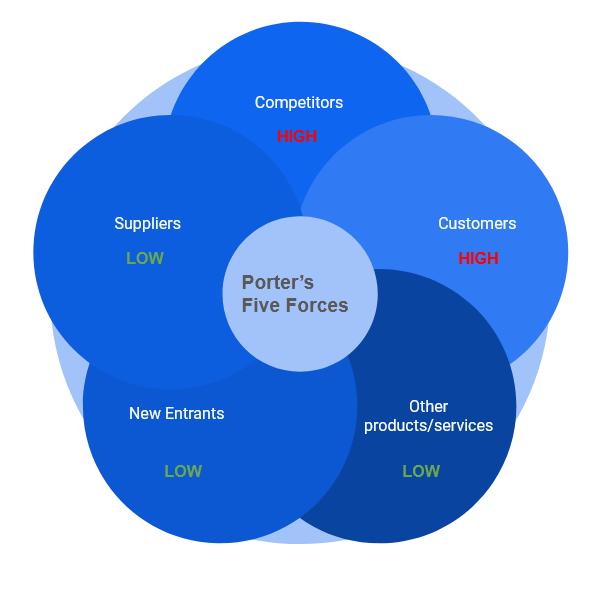
Porter’s Five Forces
- Bargaining power of customers: HIGH— The customers would be new couples. These couples would always ask different venues for quotes, but pricing was not the only criterion. Quality, scenery should also taken into consideration. Furthermore, during recession customers can just postpone their weddings or their wedding parties. Alison’s hotel offered exclusivity which was something larger hotels could not offer.
- Bargaining power of suppliers: LOW — Alison ensured that the hotel had more than one suppliers for food, beverages, decorators and anything else that a hotel needed for a wedding. She would always ask 3 offers for each wedding and ensure to get the lowest prices and the best quality
- Threat from competitors: HIGH— Competitors were other hotels which also offered wedding venues. Usually these hotels were large and had multiple wedding venues. Alison’s hotel offered exclusivity, so a couple could rest assure that the entire hotel would be at the disposal only.
- Threat from new entrants: LOW — Alison’s hotel was already established and minimum investment was required to convert the hotel hall to a wedding venue. A new entrant would need to take into consideration initial investment for venue and marketing expenses
- Threat of other products/services: LOW — Alternative services such as restaurants were not consider threatening because most couples wanted to have a luxury wedding.
PESTLE
- Political: The hotel was licensed and obeyed hotel regulations. The weddings were considered another product, so there was no changes in the taxation. Lastly, the country of Alison’s hotel was consider to have political stability.
- Economy: Economy factors such inflation and recession should always be taken into consideration. Inflation might lead to higher costs and recession might lead to less wedding events. Furthermore, currency exchange rates should be taken into consideration because most of the clients would come from different countries and they would like to pay using different currency.
- Social: Weddings and parties after weddings will continue to happen as culture events. Furthermore, changes of wedding trends might impact business such as preference for smaller, eco-friendly weddings.
- Technology: All bookings were done online, so digital marketing and providing an easy way to book and manage a wedding was essential.
- Legal: Changes in legislation such as political ceremonies or gay marriages can only help the hotel increase their clientele. Furthermore an understanding of contracts and liability laws was needed.
- Environment: Alison always took into consideration the environmental impact of a wedding and tried to reduce it with appropriate recycling. Also renewable energy with the use of photovoltaics and rainwater harvesting for the swimming pool. Weather was an important factor since most events were organised in the outside area and rain could stop them.
Internal Environment
VMOST
- Vision: To become one of the leading wedding venues of the area for unforgettable and sustainable weddings.
- Mission: To offer exclusive, affordable and quality wedding experiences.
- Objectives: Over 80 weddings per year, improve customer satisfaction to 95%, improve profitability by 20% annually by increasing revenue and reducing costs
- Strategies: Differentiate from competitors by offering exclusivity in the best price possible, invest in new technologies and focus on sustainability and eco-friendliness.
- Tactics: Tactics included launching a new website to be used for digital marketing, booking and managing weddings and streamlining processes. Lastly sustainability initiatives such as recycling/composting, zero energy hotel and reuse water by rainwater harvesting.
Resource Audit
- Key resources: A building that can be used for indoor weddings and outdoor weddings next to the swimming pool, kitchen and catering facilities.
- Financial resources: No initial capital investment was required. Hotel had no debts and wedding bookings included a deposit that was enough to provide a revenue stream.
- Human resources: Alison as general manager, two waitresses, two cleaners and a chef. More people could be allocated during the wedding events. Furthermore, ongoing training programs would be organised to enhance customer service, event planning, and sustainability skills.
- Technological resources: A website that should be transformed and used for digital marketing, booking and wedding management.
- Organisational resources: This included sustainability initiatives, collaborations with different vendors and marketing strategies to promote the venue.
- Operational resources: Operational processes needed to be defined that would take place before the wedding, during the wedding and after the wedding. This included supply chain management, event scheduling and planning and customer service and support.
1.6 SWOT analysis
An alternative method to conduct an external and internal analysis is using the SWOT analysis.
- Strengths: Great location, exclusivity, personalised weddings with emphasis on sustainability.
- Weaknesses: Small hotel so cannot accommodate large weddings which can be more profitable and also seasonal demand.
- Opportunities: Increase wedding bookings from other countries, more collaborations with wedding organisers and better online presence.
- Threats: Recession, major events such as pandemic, bad weather, competitive prices.
1.7 Business Performance Measurement
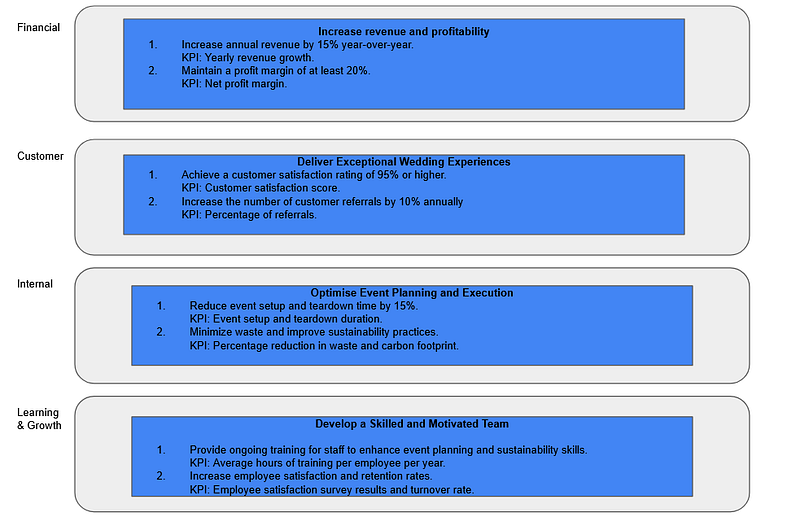
Balance Scorecard (BSC) was used to measure performance of the hotel. It includes four layers, financial, customers, internal and learning & growth. Below is the diagram that Bob created.
1.8 Business Analysis within the Lifecycle for Business Change
Bob had concluded his initial work. But before assigning tasks to the developers that would create the website he needed to ensure that everyone was clear with his role in the lifecycle for business Change.
Business Cases
Definition
A business case is a document that is presented to the management and proposes specific course of actions. Bob produced the following business cases:
- Sustainability and Eco-Friendly Business Case
- Personalization and Customisation Business Case
- Operational Efficiency Business Case
- Marketing and Branding Business Case
more details TODO
Alignment
Bob needed to ensure that the project would be aligned with Alison’s vision and strategy.
Furthermore, for each business case he performed feasibility studies to ensure that the projects will be feasible.
Definition
At this stage, the elements to support the change are defined. Bob prepared feasibility studies for all business cases, searched for options and finally defined the requirements of the different business cases.
Design
At this stage, the implementation team designed the solution of each business case. Bob helped with any clarification, with the definition of acceptance criteria for testing and acted as a liaison between the implementation team and management.
Once again, the business cases were confirmed after the design stage was finished.
Implementation
This is the stage of the actual implementation. At this stage any changes were documented as change requests and handled by Bob separately.
Business cases were revisited before deployment.
Realisation
Once, the different projects went live, Bob performed post implementation reviews and suggested further improvement opportunities.
The benefits of business cases were checked.
Waterfall vs. Agile Solution Delivery
A major decision was whether to use a waterfall or an agile solution delivery. The two methods offered different advantages but at the end it was decided to use the waterfall method because there was a clear scope, it was clear to the stakeholders what will be done and the flexibility of the agile method was not required.
2. Business Analysis Techniques
After Bob performed initial analysis for the external and internal environment, used swot analysis to provide feedback back to management, decided how he will measure business performance and finally clarified with everybody what will be his role in the lifecycle of the business changes he was ready to start deep dives.
2.1 Investigating and Documenting Business Situations
Different techniques could be used to investigate and document business situations. They can be split into two categories, qualitative and quantitative. More details LINK.
Bob decided to use the following techniques:
- Document Analysis: Alison was proud of her documentation skills. She tries to document everything that is happening in the hotel. Bob started by analysing all documents to understand the business.
- Interviews: The SMEs such as Alison would be interviewed to get a deep understanding of the current processes. Bob prepared questions according to the document analysis performed before.
- Workshop: A workshop was then organised, where all stakeholders were invited. Bob presenting his findings from the document analysis and Alison’s interview and tried to get everyone’s feedback.
- Prototyping: Finally, Mock-ups of the new website were put into place, for stakeholders to provide their input on how the new website would serve their purpose.
2.2 Stakeholder Analysis
Below are the results of the stakeholder analysis that Bob performed. He used two methods, the RASCI matrix and the power/interest grid.
Power/Interest Grid
Five steps
Step 1: Identify stakeholders
- Wedding Couple
- Guests
- Venue Owner
- Vendors
- Tourists
- Local Authorities
Step 2: Assess Stakeholder Power
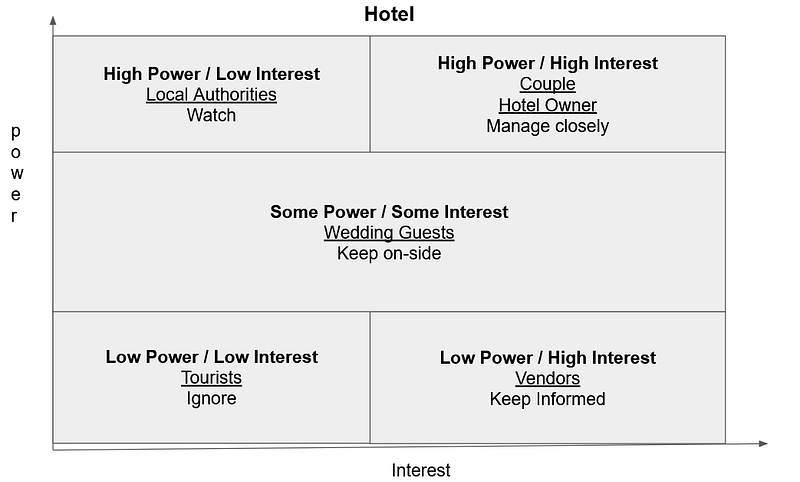
Wedding couple: They have high power and high interest. They have the final word. They must be managed closely. One of the business case is to develop a website that will keep them informed and allow them to make changes to the wedding. For example the couple could change the number of guests or which wedding cake to have.
Local Authorities: The wedding couple will be issued a wedding license by the local authorities. Although they don’t have much interest and they high power because they might change the rules at any time. They need to be watched at all time.
Wedding Guests: Some of the wedding guests, especially the close family have some power and some interest. They want to enjoy themselves and celebrate with the couple. While they don’t have direct decision-making power, they can influence the actual wedding day. They need to be kept on-side.
Tourists: Although no tourists are allowed during the wedding day because of the exclusivity, they might impact the wedding by showing up. They need to be taken into consideration but in general to be ignored.
Vendors: Vendors do not have much power but they do have high interest. A large and successful wedding would mean more income for them. They need to kept informed.
RACI matrix

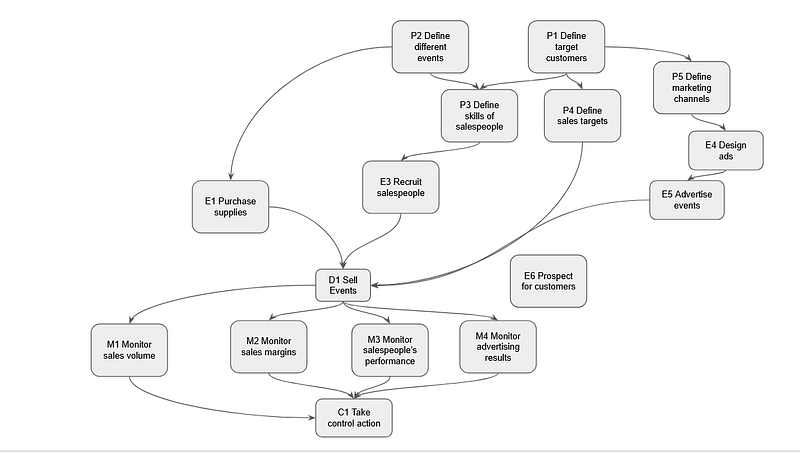
2.3 Modelling Business Activities
BAM
- Doing
- Enabling
- Planning
- Monitoring
- Controlling
Business Events
External:
- Weather: Bad weather might impact the actual wedding day since most events happen outdoors.
- Social crisis
- change on regulations
Internal:
- Vendors not delivering
- Sick personnel
- Maintenance
Time Based:
- The actual wedding day
- Specific milestones, like 2 months before the wedding day they need to apply for wedding licenses.
Business Rules
External
- New regulations on wedding licenses
- Liquor licensing regulations
- Health and safety regulations
Internal
- customer service standards
- booking and reservation policies
- Event coordination procedures
Gap Analysis
Step 1: Investigate current state
Step 2: Analyse perspectives of stakeholders
Step 3: Compare current state with desired state
Step 4: Identify actions needed to bridge the gap
Step 5: Develop a plan
3. Business Case
3.1 Rationale for Making a Business Case
It was important before making any commitment to a particular solution to evaluate the feasibility and potential outcomes of each option. Four business cases were developed. Each business case helped stakeholders make better decisions.
3.2 Contents of a Business Case and 3.3 Options
Below are the four business cases with their contents.
Sustainability and Eco-Friendly Business Case
- Management Summary: Hotel needs to focus on sustainability and eco-friendly actions. As environmental concerns and sustainable practices gain prominence in society, we recognise the need to align our operations with these values. This initiative is not only in response to changing customer preferences but also a proactive step towards reducing our environmental footprint, improving our brand image, and enhancing long-term profitability.
- Description: The traditional wedding industry often generates significant waste, consumes substantial resources, and has a considerable environmental impact. As sustainability becomes a top priority for couples and event planners, there is a growing demand for wedding venues that offer eco-friendly options. To remain competitive and responsive to market trends, our hotel must adapt and embrace sustainable practices.
- Options: a) do nothing, b) waste reduction c) green energy d) sustainable sourcing
- Costs and Benefits: Investing in recycle bins, a photovoltaic system and use local vendors. The benefits will be reduced costs and enhanced brand image.
- Impact Analysis: Reduce carbon footprint, waste reduction, cost savings and brand enhancement.
- Risk Analysis: Initial investment cost, staff will need additional training, event disruption.
- Recommendations: Perform options b-d.
Personalization and Customisation Business Case
- Executive Summary
- Description:
- Options:
- Costs and Benefits
- Impact Analysis
- Risk Analysis
- Recommendations
Operational Efficiency Business Case
- Executive Summary:
- Description:
- Options:
- Costs and Benefits:
- Impact Analysis:
- Risk Analysis:
- Recommendations:
Marketing and Branding Business Case
- Executive Summary:
- Description:
- Options:
- Costs and Benefits:
- Impact Analysis:
- Risk Analysis:
- Recommendations:
3.4 The Financial Case
- Benefit, cost and risk of options.
- whether the organisation can afford the proposed solution.
- Justification for undertaking the project.
3.5 Investment Appraisal Techniques
- Break-even analysis
- Discounted cash flow
- Return analysis
3.6 Risk Analysis
Risk Acceptance:
Risk Avoidance
Risk Mitigation
Risk Transfer
0 Comments
No comments yet. Be the first to start the conversation!
Leave a Response