Why is Business Analysis important?

Introduction
Unhappy Bank recognizes the need to undertake a digital transformation initiative and rebrand itself as Happy Bank. The bank is hindered by legacy systems that are plagued with bugs, causing problems for its users and most importantly customers.
This is the (fantastic) story of Unhappy Bank’s successful digital transformation journey, aimed at providing a comprehensive overview of the business analysis domain. Drawing on personal experiences, this story is intended to cover the key topics of the International BA Diploma by BCS, as outlined in its syllabus. Through this list of business analysis articles, readers can gain insights into the importance of effective business analysis that can help align business needs and business change solutions.
What are Business Analysts used for?
To ensure a successful digital transformation project, Unhappy Bank engaged a team of Business Analysts to analyse the initiative. The team’s role extended from the initial discussions through to the go-live phase, with a focus on identifying the organisation’s business needs and objectives, analysing existing processes and systems, defining requirements and specifications, facilitating communication and collaboration, and measuring the impact of the project. By engaging Business Analysts from the beginning of the project, Unhappy Bank was able to ensure that its digital transformation initiative was aligned with its business goals and delivered measurable value.
Business analysts were required for several reasons:
- Identify business environment
- Define the current state of the Unhappy Bank’s IT systems.
- Analyze existing processes and systems
- Measure the impact of digital transformation
- Decide on business changes needed
- Make a list of stakeholders
- Model business activities
- Document business cases
- Perform risk analysis
- Present a financial case to the project sponsor
- Create an impact analysis
- Consider legal issues
- Define requirements and specifications
Importance of Holistic View
Below are the main reasons for having a holistic view of a business ecosystem:
- To ensure that technology investments align with the organization’s vision and that digital transformation initiatives deliver measurable value.
- Identification of dependencies: A holistic view enables business analysts to identify dependencies between different systems, processes, and stakeholders. By understanding these dependencies, business analysts can develop strategies that address complex challenges and ensure that all parties are aligned on project goals and objectives.
- Identification of risks and opportunities: A holistic view enables business analysts to identify risks and opportunities associated with digital transformation initiatives. By taking a broad perspective, business analysts can identify potential risks, such as technology limitations, and develop strategies to mitigate these risks. They can also identify opportunities, such as process improvements, that can drive business growth and deliver measurable value.
A model that can be used for understanding a holistic perspective is the POPIT model.
- People: Unhappy Bank recognized that their employees are the key to providing excellent customer service and driving innovation. They invested in training programs, mentoring, and career development to ensure that their employees have the necessary skills and knowledge to perform their jobs effectively. Furthermore a decision was made to involve most of the people in this digital transformation project. More on this later on the story for stakeholder analysis.
- Organisation: The bank ensured that their organizational structure was aligned with their business objectives and customer needs. They established cross-functional teams to work on gathering requirements to help the Business Analysts.
- Processes: The Bank recognized that streamlined and efficient processes are essential to providing excellent customer service and improving overall organizational performance. They engaged with the Business Analysts to identify pain points and inefficiencies in their current processes and develop new processes that are streamlined, efficient, and customer-centric.
- Information and Technology: The Bank engage with the Business Analysts to identify customer needs and develop technology solutions that meet those needs. The Bank required the technology solutions to be well-established and proven to work before implementing them. The bank also invests in cybersecurity solutions to ensure the security and privacy of customer data.
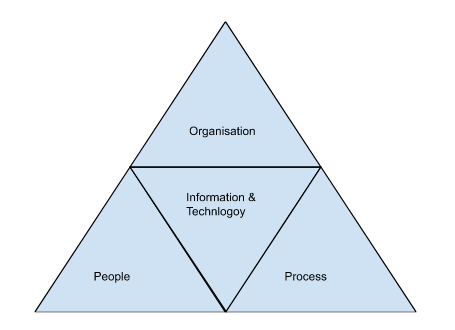 POPIT Model: Diagam I made myself in Google Docs
How the Techniques for Strategy Work Together
Below is a diagram that illustrates how all techniques work together.
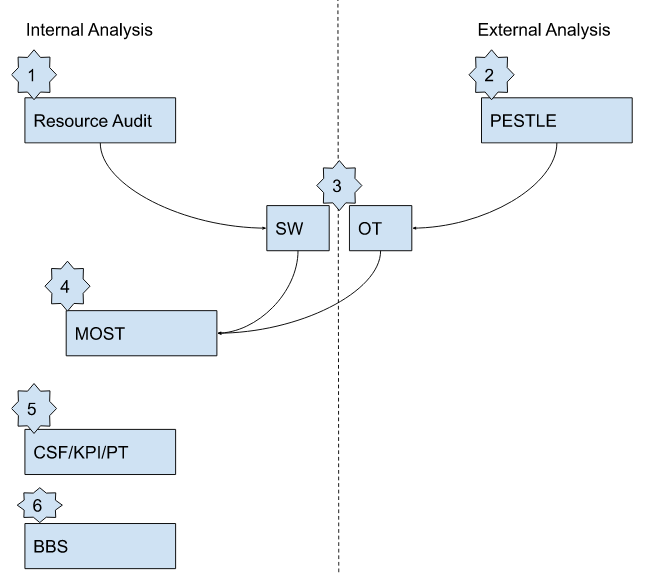 All techniques together
1 Resource Audit : “What do we have now?”
2 PESTLE: “What external factors might impact the organisation?”
3 SWOT: “How can we consolidate the internal and external factors to find areas to change?”
4 MOST or VMOST: “what is our vision, our goals, our objectives and how do we get there?”
5 CSFs: “how do we validate we have the right mission?
KPIs/PTs “how do we measure the most important areas
6 BBS “How can we identify additional CSFs and KPIs”